
Why Your Historic St. Louis Home Needs Lime Mortar, Not Portland Cement
Discover why using hard Portland cement on historic St. Louis brick causes permanent damage and why soft lime mortar is essential for your home's longevity.
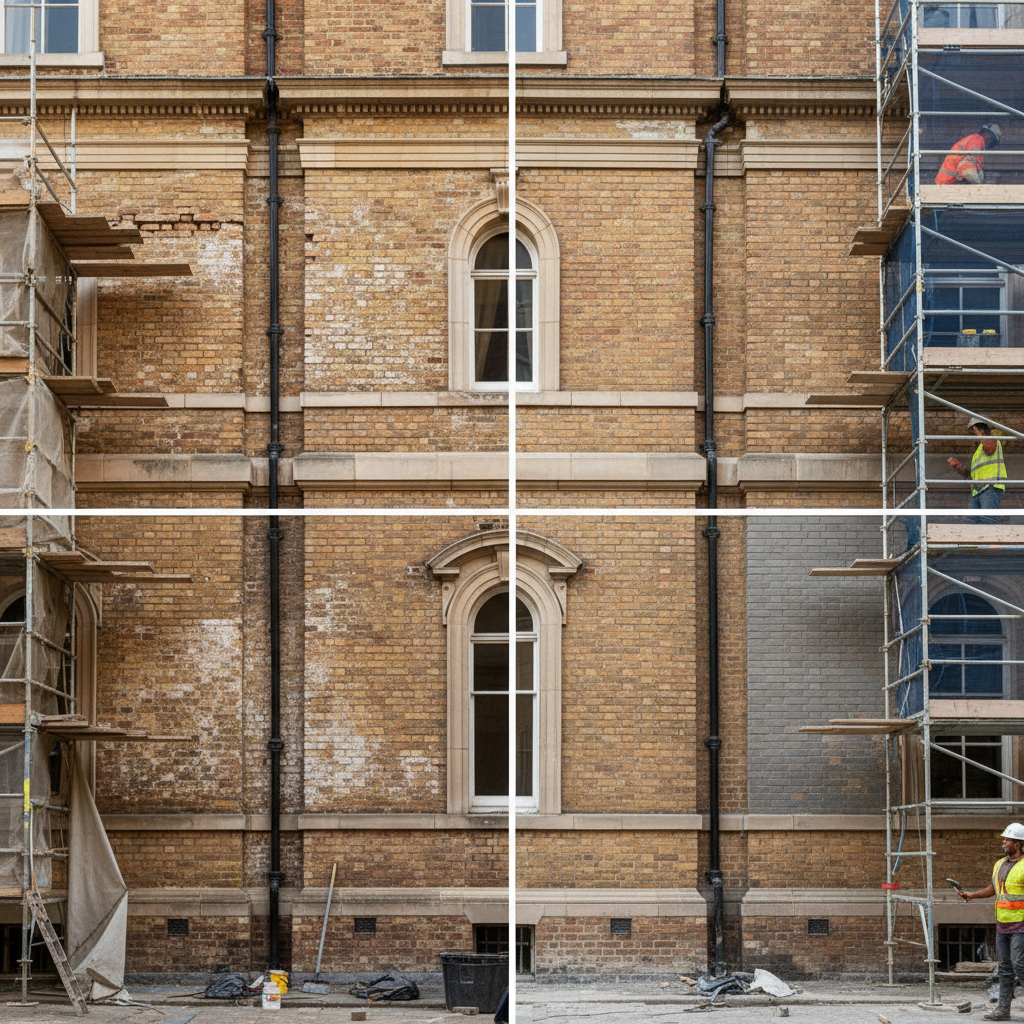
Key Takeaways
- Historic St. Louis brick is softer and more porous than modern brick.
- Portland cement is too hard and brittle for vintage masonry, leading to trapped moisture and cracked bricks.
- Lime mortar acts as a sacrificial layer that breathes, allowing moisture to escape the building envelope.
- Using the wrong mortar on a 1920s bungalow or Soulard brownstone can lead to irreversible structural decay.
- Always consult an expert masonry contractor familiar with historic preservation before tuckpointing your home.
Why Does Pre-1940 St. Louis Brick Require Lime Mortar?
Pre-1940 St. Louis brick requires lime mortar because it is designed to be softer and more breathable than the brick itself to prevent structural failure. When I walk through neighborhoods like The Hill, Tower Grove, or Soulard, I see thousands of homes built before the widespread adoption of modern, high-strength Portland cement. These buildings were engineered to 'breathe.' In a freeze-thaw climate like ours in Missouri, moisture inevitably enters the masonry. Lime mortar acts as the escape route for this moisture, drying out through the joints rather than through the face of the brick. If you use a rigid material, you turn a flexible wall into a stiff, brittle structure that cannot handle the natural thermal expansion and contraction of our St. Louis weather.
What Happens When You Use Hard Portland Cement?
Using hard Portland cement on historic brick forces moisture to evaporate through the brick face instead of the mortar joints, causing the brick to 'spall' or flake apart. I have spent years fixing work done by well-meaning but misguided contractors who filled old joints with heavy, grey Portland cement. The result is almost always a disaster. Because the cement is harder than the brick, the mortar does not crack, but the brick does. Once the brick begins to spall, it loses its structural integrity and its protective outer skin. Over a few St. Louis winters, that moisture freezes, expands, and blows the face off the brick, leading to expensive wall rebuilds instead of simple tuckpointing repairs.
| Feature | Lime Mortar | Portland Cement | | :--- | :--- | :--- | | Flexibility | High (Self-healing) | Low (Rigid) | | Breathability | High | Negligible | | Curing Time | Slow | Rapid | | Suitability | Historic Brick (Pre-1940) | Modern Brick (Post-1960) |
How Can You Tell Which Mortar Was Used on Your Home?
You can identify incorrect mortar by checking if the joint is harder than the brick and if there is visible spalling or 'pop-outs' on the brick faces. A simple test you can perform at home is the scratch test. Take a screwdriver and gently scratch the mortar in an inconspicuous area. If the mortar is soft, sandy, and light-colored, it is likely the original lime-based mix. If the mortar is rock-hard, dark grey, or impossible to scratch, it is likely Portland cement. If you see chunks of brick missing or 'shelf-like' layers peeling off the surface, you are likely looking at damage caused by a previous repair that used the wrong material.
Can Your Historic Home Be Repaired Properly?
Yes, your home can be restored to its original health by carefully grinding out the incompatible Portland cement and repointing with a historically accurate lime-based mortar. This process is labor-intensive and requires a skilled touch to match the original mortar color and texture, but it is the only way to stop the damage. At Anchor Masonry, we have been preserving the character of St. Louis homes since 1987. We understand the specific needs of the local clay and the historic standards required to keep these homes standing for another century. We treat your home as if it were our own, ensuring that we never use materials that could jeopardize the foundation or the masonry units.
How Do You Get Started with Anchor Masonry?
To get a professional assessment of your mortar condition, call our team at (314) 775-4557 for a free, no-obligation estimate. I am Adam Scott, and as a family-run business, we pride ourselves on being BBB A+ accredited and honest about what your home actually needs. Whether you live in a historic district or a charming neighborhood bungalow, you deserve a repair that lasts. Don't wait for the next freeze-thaw cycle to damage your brick further. Give us a call today, and let’s make sure your home is properly protected for the next generation of St. Louis residents.
Adam Scott
Owner, Anchor Masonry - 38+ years of masonry experience in St. Louis